
Pedestrian safety remains an important concern for cities around the world. As urban populations grow and roads become increasingly busy, traditional crossing methods may not always provide enough protection for people walking near traffic.
Technology is creating new ways to make pedestrian crossings more responsive. A smart pedestrian crossing system can combine sensors, signals, communication technology, and automated controls to improve how vehicles and pedestrians interact at busy road locations.
The Challenge of Traditional Crossings
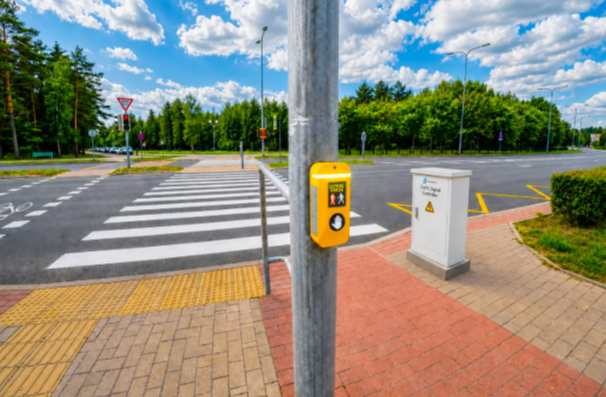
Conventional pedestrian crossings often depend on fixed signals or manually activated buttons.
While these systems can be effective, they may not always respond to changing traffic and pedestrian conditions.
A crossing may remain active even when no pedestrians are present, or pedestrians may need to physically touch a control to request a crossing phase.
Smart systems aim to make this interaction more responsive.
What Makes a Crossing Smart?
A smart crossing can use technology to detect pedestrians, monitor traffic conditions, and communicate information to connected control systems.
Depending on the installation, sensors may identify people waiting to cross and trigger appropriate signals.
The objective is not simply to automate the crossing but to improve the overall interaction between road users.
Contactless Activation
One useful development is contactless pedestrian detection.
Traditional push buttons require people to touch a physical surface. Contactless systems can allow a crossing request to be activated without direct contact.
This can be useful in busy public environments where many people interact with the same infrastructure throughout the day.
Improving Accessibility
Pedestrian infrastructure needs to work for people with different mobility requirements.
A smart crossing can potentially incorporate visual, audible, or other forms of information to make crossing instructions clearer.
The exact features depend on local regulations and the system installed.
Reducing Unnecessary Waiting
Technology can help crossings respond more efficiently to actual demand.
When a system detects a pedestrian waiting to cross, it can communicate with the traffic control system according to programmed rules.
This can help reduce unnecessary crossing cycles and support more efficient traffic management.
Supporting Traffic Flow
Pedestrian safety and vehicle movement do not have to be competing priorities.
A well-designed smart crossing can coordinate pedestrian requests with traffic signal timing.
This allows cities to manage crossings while considering overall traffic conditions.
Busy Urban Areas
Smart crossings can be particularly useful in areas with high pedestrian activity.
Examples include:
- Shopping districts
- Transport hubs
- School zones
- Tourist areas
- Business centers
- Hospital surroundings
- University campuses
These locations often experience changing pedestrian volumes throughout the day.
School Zones
Children may require additional consideration around road crossings.
Smart technology can provide another layer of information and control in areas where pedestrian activity increases during school arrival and departure times.
However, technology should complement rather than replace appropriate road design and traffic management.
Data and Traffic Management
Connected crossing systems can potentially provide useful operational information.
Traffic authorities may be able to understand when crossings are most frequently activated and how pedestrian demand changes throughout the day.
This information can support future infrastructure planning.
Reducing Physical Contact
Contactless technology has another practical benefit: reducing the number of people touching shared public surfaces.
In busy environments, this can make the interaction more convenient for users.
The system can be designed to detect a person approaching or waiting within a designated area rather than requiring physical contact.
Reliability Is Essential
A smart crossing must be reliable.
Road infrastructure operates in environments where weather, dust, vibration, and continuous use can affect equipment.
Sensors and control components therefore need to be selected and installed appropriately for outdoor conditions.
Regular maintenance is also important.
Integration With Existing Infrastructure
Cities do not necessarily need to replace their entire traffic network to adopt smart technology.
Depending on the design, modern crossing equipment may be integrated with existing signal systems.
Before installation, engineers should assess compatibility with the current traffic-control infrastructure.
Maintenance and Monitoring
Like any electronic road system, smart crossings require ongoing maintenance.
Sensors should be checked regularly, and damaged equipment should be repaired promptly.
Remote monitoring capabilities can potentially help authorities identify problems more quickly.
Energy Efficiency
Modern traffic infrastructure is also increasingly focused on efficient energy use.
LED indicators, efficient electronics, and intelligent activation can contribute to reducing unnecessary energy consumption.
The actual savings depend on system design and operating conditions.
Designing for the Future
Urban mobility is becoming increasingly connected.
Smart crossings can form part of a larger intelligent transportation network where traffic signals, pedestrian systems, public transport, and road monitoring technologies communicate with one another.
This creates opportunities for cities to manage transportation more dynamically.
Choosing the Right Technology
When evaluating a smart pedestrian crossing system, authorities should consider detection accuracy, reliability, compatibility, accessibility, maintenance requirements, environmental conditions, and local regulations.
The system should be selected according to the specific road environment rather than simply choosing the newest available technology.
Conclusion
Smart pedestrian crossings represent an important development in modern urban transportation.
By combining pedestrian detection, contactless activation, traffic coordination, and connected technology, these systems can help cities create safer and more responsive crossing environments.
Technology alone cannot solve every pedestrian safety problem, but when combined with good road design, appropriate signage, traffic management, and regular maintenance, a smart pedestrian crossing system can become a valuable part of a modern transportation network.