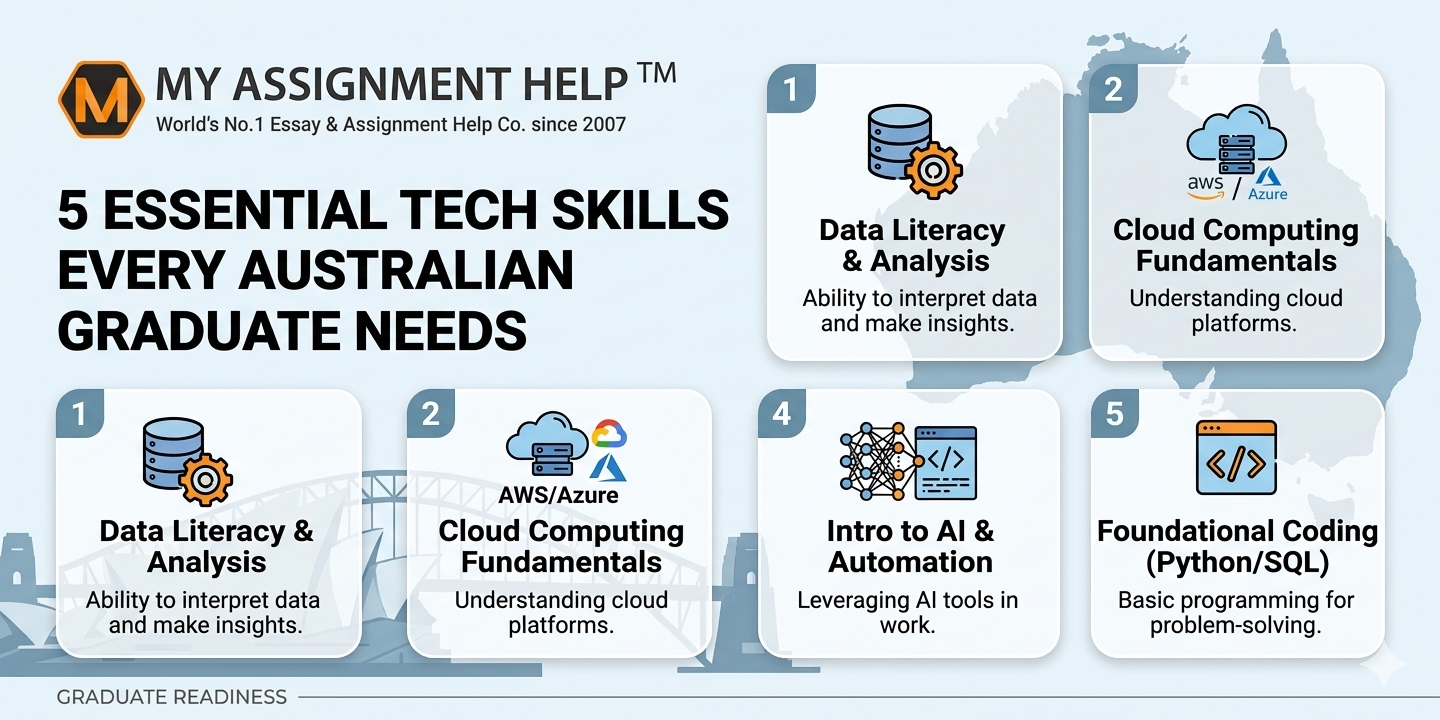

The Australian graduate labor market is undergoing a seismic shift. While a degree in your chosen field—be it Nursing, Commerce, or Fine Arts—remains a vital foundation, the Graduate Outcomes Survey (GOS) consistently highlights a growing gap between academic theory and the digital fluency required by modern employers.
In a landscape defined by the “Digital Skills Gap,” being “tech-savvy” no longer means just knowing how to send an email or navigate a social media feed. It involves a fundamental understanding of the infrastructure that powers our economy. For many students, the complexity of these technical systems can be a hurdle, leading them to seek specialized computer network assignment help to bridge the gap between classroom concepts and industry application. Whether you are entering the healthcare sector in Melbourne or the financial hub of Sydney, the ability to navigate digital ecosystems is the new baseline for career longevity.
As the Australian government’s Digital Economy Strategy 2030 accelerates, graduates who lack specific digital competencies risk being sidelined. To ensure your transition from university to the workforce is seamless, here are the five essential tech skills every Australian graduate must master, regardless of their major.
1. Data Literacy and Interpretation
Data is the “new iron ore” of the Australian economy. From analyzing patient outcomes in health clinics to tracking consumer trends in retail, data literacy is no longer restricted to Data Scientists.
Why it matters:
Employers value graduates who can move beyond gut feelings to make evidence-based decisions. This doesn’t mean you need to be a statistician, but you must be able to read, work with, and argue with data. In Australia, the demand for roles requiring data skills has grown by 60% in the last five years.
The Application:
- Business/Arts: Using Excel or Google Sheets for pivot tables and trend analysis.
- Education: Interpreting NAPLAN or internal assessment data to pivot teaching strategies.
2. Artificial Intelligence (AI) Fluency
With the rapid integration of Generative AI in the Australian workplace, “AI Fluency” has become a non-negotiable skill. It isn’t about letting AI do your work; it’s about “Prompt Engineering” and understanding the ethical implications of AI.
The Strategic Edge:
The CSIRO’s Artificial Intelligence Roadmap suggests that AI could contribute $22.17 trillion to the global economy by 2030. Graduates who understand how to use AI tools like ChatGPT, Claude, or industry-specific bots to automate mundane tasks will have significantly higher productivity levels.
3. Cybersecurity Hygiene and Awareness
The 2022-2023 Optus and Medibank data breaches were a wake-up call for Australia. No matter your job title, you are a gatekeeper of corporate and client data.
Essential Knowledge:
Understanding the basics of the “Essential Eight”—a set of mitigation strategies developed by the Australian Signals Directorate (ASD)—is highly regarded by Australian recruiters. Graduates must understand phishing detection, the importance of Multi-Factor Authentication (MFA), and secure data handling protocols.
If you find the technicalities of secure architectures overwhelming during your studies, professional assignment writing help can provide the conceptual clarity needed to master these topics before you hit the professional world.
4. Digital Project Management Tools
The “Monday to Friday, 9 to 5” office culture is evolving into a hybrid model across Australia. To thrive, you must be proficient in collaborative digital platforms.
Tools to Master:
- Asana/Trello/Jira: For task tracking and workflow transparency.
- Slack/Microsoft Teams: For asynchronous communication.
- Miro/Lucidchart: For visual brainstorming and process mapping.
5. Cloud Computing Fundamentals
The transition from local servers to the Cloud (AWS, Azure, Google Cloud) is nearly complete in the Australian corporate sector. Understanding “The Cloud” isn’t just for IT majors anymore.
Industry Context:
A Marketing graduate needs to understand how Cloud-based CRMs (like Salesforce) store customer data. A Construction graduate needs to know how BIM (Building Information Modeling) software syncs across devices via the cloud. Understanding the scalability and accessibility of cloud environments is a foundational literacy for the modern professional.
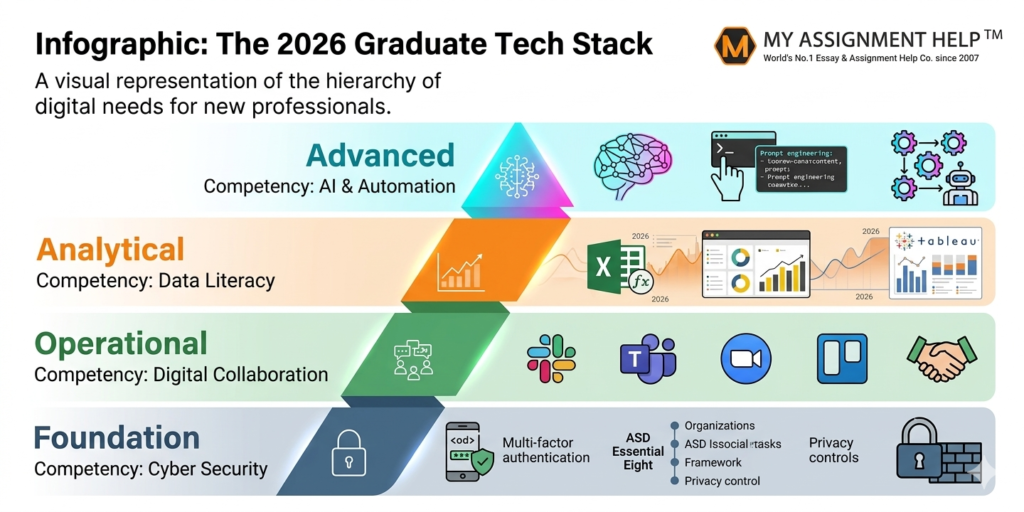
Key Takeaways
- Digital Skills are Universal: No major is “tech-exempt” in the current Australian job market.
- Focus on Data: The ability to interpret data is the most sought-after “soft-tech” skill.
- Prioritize Security: Basic cybersecurity knowledge protects both you and your employer.
- Embrace AI: Use AI as a co-pilot to enhance your human creativity and critical thinking.
- Be a Lifelong Learner: The tech stack of 2026 will look different by 2030; stay adaptable.
See also: AR Changing the Way We See the World
FAQs
Q: I studied a Bachelor of Arts; do I really need to know about Cloud Computing?
A: Yes. Whether you’re working in a gallery, a government department, or a non-profit, your records, communications, and project management will likely be cloud-based. Understanding the infrastructure ensures you can troubleshoot and manage data effectively.
Q: What is the “Essential Eight” mentioned?
A: It is a framework by the Australian Cyber Security Centre (ACSC) designed to help organizations mitigate cyber threats. Knowing these principles shows employers you take data integrity seriously.
Q: How can I improve my data literacy for free?
A: Platforms like Microsoft Learn and LinkedIn Learning offer free introductory courses on Excel and Data Visualization that are highly applicable to the Australian context.
References
- Australian Government, Department of Industry, Science and Resources (2023). Australia’s Digital Economy Strategy 2030.
- CSIRO (2024). Artificial Intelligence Roadmap: Navigating the Future.
- Graduate Outcomes Survey (GOS) 2025 Report on Labor Market Transitions.
- Australian Signals Directorate (ASD). The Essential Eight Explained.
About the Author
Dr. Helena Miller is a Senior Academic Consultant at MyAssignmentHelp. With over 12 years of experience in the Australian higher education sector, Helena specializes in bridging the gap between academic curriculum and industry requirements. She has contributed to numerous white papers on digital literacy and works closely with students to enhance their technical competencies through data-driven content and professional guidance.