
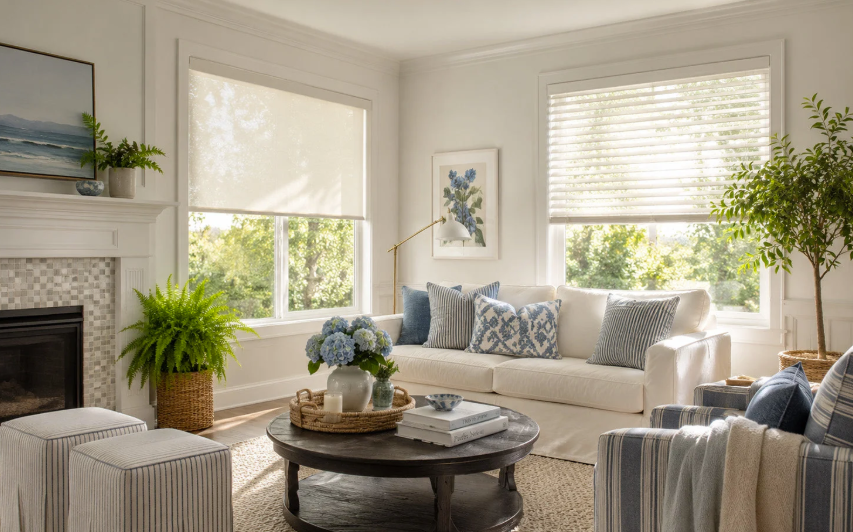

Choosing blinds becomes much easier when the decision starts with the window and the way the room is used.
It is tempting to compare products mainly by colour, fabric or photographs, but those details should come later. A blind first needs to fit the opening correctly, work with handles and doors, provide the right balance of privacy and daylight, and remain convenient to operate every day.
A useful shortlist therefore starts with four questions:
- What type of opening is being covered?
- What does the room need from the blind?
- How much light and privacy control is required?
- How often will the blind be adjusted or moved?
Once those answers are clear, the differences between blind types become far more meaningful.
Start with the opening before comparing styles
Every blind has to work with the physical window or door.
Before looking at fabrics or colours, check:
- width and height;
- available recess depth;
- handles and locks;
- trickle vents;
- hinges;
- opening direction;
- fixing surfaces; and
- nearby furniture or fittings.
These details can eliminate unsuitable options immediately.
A blind may look ideal in a photograph but still be impractical if it blocks a handle, reduces door clearance, or prevents the window from opening properly.
The first stage of the decision should therefore be about compatibility rather than appearance.
See also: The Skill-to-Salary Bridge: 5 Essential Tech Skills Every Australian Graduate Needs
Decide how much control the room actually needs
Different rooms create different requirements.
A bedroom may need stronger evening privacy and better control over early-morning light. A living room may benefit from maintaining daylight while reducing glare. A home office may need more frequent adjustment throughout the day.
The goal is not always maximum coverage.
In many rooms, the better solution is one that allows the amount of light or screening to be changed as conditions change.
For homeowners considering vision blinds Stockport, it is useful to think specifically about how often privacy and daylight requirements change during the day. A blind that allows more flexible adjustment may make sense where the room alternates between bright, open use and periods when greater screening is wanted.
Daytime privacy and night-time privacy are different
Privacy is often discussed as though it were a fixed characteristic of a blind.
In reality, conditions change.
During daylight hours, the difference between outdoor and indoor light can affect how visible the room is from outside. After dark, interior lighting can make the same room much more exposed.
This means homeowners should think about when privacy is most important.
- Is the room overlooked by neighbouring properties?
- Does the window face a public path or road?
- Is privacy mainly required during the evening?
- Is retaining daylight important during the day?
- Does the household want partial screening rather than complete coverage?
Testing these situations mentally before choosing a blind gives a much clearer brief.
Doors require a different type of planning
A glazed door should not be treated exactly like a fixed window.
Doors move, handles project from the frame, and the blind may sit on an opening that is used many times during the day.
Before choosing a door blind, check:
- how the door opens;
- whether it swings inward or outward;
- how far the handle projects;
- whether the blind will move with the door;
- how frequently the doorway is used; and
- whether the blind remains stable during normal operation.
People researching door blinds Stockport should therefore judge the blind in both the open and closed positions. A product that covers the glazing effectively but makes the door awkward to use is not a strong long-term solution.
Frequent use should influence the mechanism
A blind that is adjusted once every few days has different demands from one that is moved several times every morning and evening.
Operation matters.
- Consider:
- where the controls are positioned;
- whether they are easy to reach;
- whether furniture blocks access;
- how much effort is needed to adjust the blind; and
- whether the blind can be used without interfering with the window or door.
The best mechanism is often the one that becomes almost unnoticed in everyday life.
If a blind constantly requires extra steps or awkward handling, the initial visual appeal will quickly become less important.
Look at the blind when it is open as well as closed
Most blinds are marketed in their closed or partially closed position.
The open position deserves equal attention.
- Ask:
- How much of the glass remains covered?
- Where does the fabric or mechanism sit?
- Does the stack block part of the view?
- Does the blind make a small window feel crowded?
- Can the window or door still open normally?
These questions are particularly important for smaller openings or doors where available space may already be limited.
Room use should influence the material
The same blind mechanism can perform differently depending on the material selected.
A kitchen, bedroom, living room, and home office do not have identical needs.
Consider the room’s:
- moisture;
- exposure to cooking;
- amount of direct sunlight;
- cleaning requirements;
- need for privacy; and
- frequency of use.
Appearance still matters, but the material should be able to cope with the environment in which it will be used.
A fabric that looks attractive in a sample book is not automatically the most practical choice for every room.
Door blinds should preserve access
The primary purpose of a door is movement between spaces.
Any blind fitted to or around it should respect that function.
A doorway may be used dozens of times a day, especially where it leads to a garden, patio, utility area, or balcony.
For homeowners considering door blinds Pudsey, the most important questions are often practical ones: whether handles remain clear, whether the door opens fully, whether the blind stays stable during movement, and whether everyday access remains straightforward.
A door blind should make the glazing easier to manage without turning the doorway into an obstacle.
Light control should be matched to the problem
Terms such as privacy, dimout, and blackout are often treated as though they describe one simple scale.
The reality is more nuanced.
A room may need:
- softer daylight;
- glare reduction;
- stronger evening privacy;
- protection from direct sunlight; or
- greater darkness for sleeping.
These are different problems.
The fitting method, fabric, gaps around the blind, and the way the mechanism operates can all influence the result.
It is therefore better to define the required outcome before choosing a product category.
Maintenance should be considered before buying
Blinds are part of everyday household use, so cleaning and upkeep matter.
Think about:
- how easily dust can be removed;
- whether the fabric is appropriate for a busy room;
- whether controls will be handled frequently;
- whether the window glass remains accessible; and
- how difficult it will be to reach the blind.
A product that is simple to maintain may be more valuable in the long term than a more elaborate design that requires constant care.
Professional measuring can prevent avoidable compromises
Made-to-measure blinds depend on accurate assessment of the opening.
Width and height are only part of the process.
Useful measurements can include:
- recess depth;
- squareness;
- handle projection;
- vent positions;
- frame details;
- opening direction; and
- suitable fixing points.
The chosen blind type should also be considered during measuring.
A fitting position that suits one system may not work equally well for another.
Professional measuring can help identify these conflicts before the product is manufactured.
Use a simple decision framework
Before making the final choice, compare each option against the same criteria.
- Fit – Can the blind be installed without interfering with handles, vents, or movement?
- Function – Does it provide the privacy and light control the room genuinely needs?
- Operation – Is it easy enough to adjust as often as the household expects to use it?
- Access – Can windows and doors continue to open normally?
- Maintenance – Is the material practical for the room?
- Appearance – Does the blind suit the proportions and design of the space?
This order keeps the decision practical.
Appearance matters, but it should refine a suitable solution rather than rescue an unsuitable one.
The best choice should make sense in ordinary language.
A good blind specification should be easy to explain.
You should be able to say:
- it fits the opening correctly;
- it works with the way the window or door moves;
- it provides the right amount of privacy and light control;
- it is convenient to operate; and
- it suits the room.
If the decision depends mainly on a product name or marketing description, more practical questions probably need answering.
The strongest choice is usually not the most complicated blind. It is the one that works naturally with the opening and the household’s routine.
Frequently Asked Questions
What should I check before comparing different blind types?
Start with the physical opening. Measure the width, height, and available depth, then check handles, vents, hinges, and opening movement. After unsuitable fitting options have been removed, compare privacy, light control, operation, and maintenance.
Are vision blinds useful where privacy needs change during the day?
They can be worth considering where homeowners want adjustable control between openness and screening. However, the actual result depends on the fabric arrangement, fitting, and lighting conditions, particularly after dark. The room’s real privacy pattern should be considered before choosing.
What is most important when choosing blinds for a door?
Door movement and access come first. The blind should not obstruct handles, locks, or the opening path, and it should remain convenient to use if the door is opened frequently. Privacy and light control can then be considered within those physical constraints.
Should the same blind type be used throughout the whole house?
Not necessarily. Different rooms and openings can have different privacy, glare, maintenance, and access requirements. Coordinating colours or materials can provide visual consistency without requiring every window to use the same blind mechanism.
Why is professional measuring useful for made-to-measure blinds?
Professional measuring can account for recess depth, uneven openings, handles, vents, fixing surfaces, and window or door movement as well as basic width and height. This makes it easier to confirm whether the selected blind and fitting method are suitable before manufacture.
